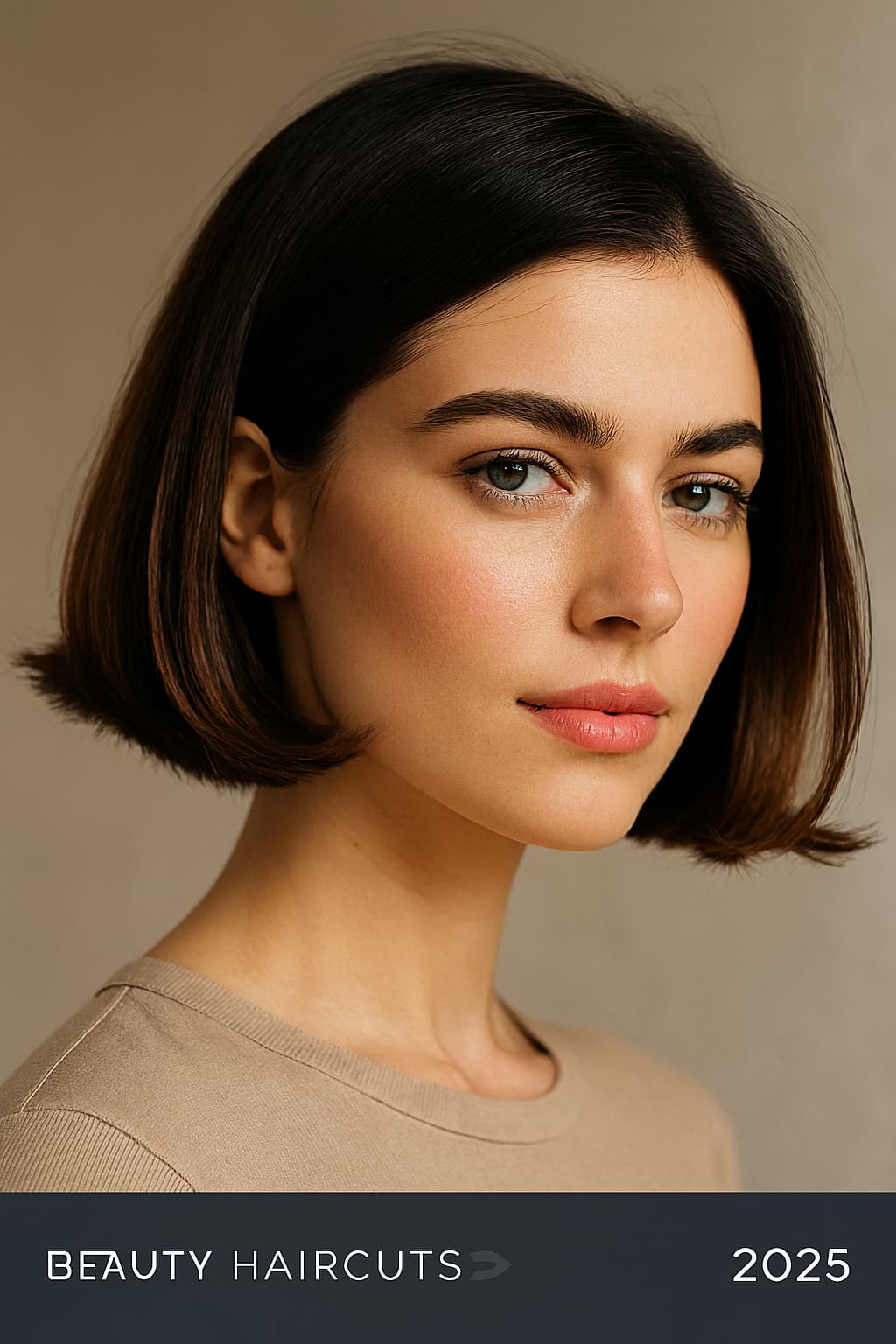
It’s a quiet Tuesday morning at the salon, and a client slides into my chair with a saved folder of bob inspiration.
She has a round face, soft features, and a worry she’s voiced before: “Every time I try a bob, I look wider.”
I hear versions of this sentence at least three times a week.
A bob on a round face can absolutely work — and it does, beautifully — when the shape is deliberate.
Not just “short,” but strategically weighted, angled, or textured in ways that guide the eye vertically rather than horizontally.
The current bob renaissance isn’t about one single cut.
It’s a spectrum of lengths, partings, and interior shapes, all riding a wave of French-girl ease and the low-effort styling everyone secretly wants.
But the real secret no Pinterest board tells you is that the success of the cut hangs on a millimeter’s difference where the hair hits the jaw, the way your stylist handles bulk at the sides, and how willing you are to pick up a round brush on a humid Wednesday.
I’ve seen chin-length bobs make a face look suddenly sculpted and sharp.
I’ve also seen the same length make someone cancel dinner plans because they couldn’t get it to sit right.
So before you scroll any inspiration, know this: the right bob for a round face almost always does one of three things.
It creates an elongated line below the chin.
It uses asymmetry to break up the softness.
Or it introduces height at the crown without adding shelf-like volume at the cheeks.
The 16 cuts that follow each lean into at least one of those ideas.
But I’ve also spelled out the maintenance trade-offs and the styling minutes you’ll actually need, because the gap between the inspiration photo and your Tuesday morning reality is where most hair regret lives.
1. The Asymmetrical Bypass Bob

Visually, this cut does exactly what the name suggests — one side hits just above the shoulder while the opposite side lands closer to the jaw.
The imbalance draws the eye diagonally, instantly making a round face feel less circular.
I’ve noticed it works brilliantly on straight to slightly wavy hair, where the longer side can sweep forward without springing up.
If your hair is tightly curly, the asymmetry can disappear into the curl pattern unless you keep the longer side significantly longer — something to discuss in the consultation.
Texture-wise, medium density is a sweet spot.
Very fine hair can struggle to hold the shape at the shorter side, often collapsing inward near the ear by 4 p.m.
On thick hair, the stylist will need to remove internal weight from the heavier side; otherwise it can puff out at the cheek, which defeats the purpose.
Styling difficulty sits around medium — a quick pass with a flat iron on the longer side keeps the line crisp, but you can also let it air-dry into a softer bend if your texture cooperates.
Maintenance involves a trim every 6–7 weeks because the asymmetry loses its edge the moment the two sides start to grow toward each other.
Ask your stylist to cut the shorter side on dry hair if your hair has even a hint of wave, because the shrinkage surprise is real.
2. The Collarbone Lob With Interior Invisible Layers

Some of the best cuts for round faces aren’t technically bobs — they’re long bobs that graze the collarbone.
That length is forgiving, elongates the neck, and draws attention downward.
The key to this one lies in the word “interior.”
Visible layers can actually create width around the cheeks.
So the smarter move is to ask for invisible layering that removes density from inside the shape without changing the outer line.
The result looks like a blunt lob from the outside but moves with a lighter, swishy quality.
This works on straight, wavy, and even curly textures, though curly girls should be clear about how much shrinkage they get when dry.
If the invisible layers are cut too short on wet curly hair, they can spring up into a triangular silhouette that widens exactly where you don’t want it.
Styling is beginner-friendly: a loose center part, a little blow-dry cream, and a round brush concentrated only at the roots for lift.
The collarbone length buys you extra time between trims — 8 to 10 weeks — and the grow-out is remarkably graceful.
One caveat: on very limp, baby-fine hair, those invisible layers can sometimes leave the ends looking see-through after a month.
Ask the stylist to keep the layering minimal and concentrated just at the crown.
3. The Deep Side-Part French Bob

This is the bob you see on effortlessly chic Parisian women who look like they woke up five minutes ago.
It usually sits between the earlobe and jawline, with a heavy side part that sweeps hair diagonally across the forehead.
That diagonal line is what makes it so good for round faces: it slices across the cheek’s widest point instead of framing it squarely.
Natural wave or light bend makes this cut sing.
Poker-straight hair can look a little severe unless you add texture spray and piece it out with your fingers.
The biggest mistake I see is keeping it too blunt and uniform across the bottom — that creates a helmet effect that widens the face.
Ask for subtle graduation at the nape so the shape lifts slightly in back, which pushes the eye upward.
Maintenance is medium-high because the strong part line needs a freshening up every 5–6 weeks.
Without a trim, the front section starts merging with the shorter back and the asymmetry blurs.
Styling time: 10 minutes on a good day, 20 if you’re battling humidity.
4. The Razored Textured Bob With Whisper Ends

This one’s for anyone who hates looking “done.”
A razor-cut bob takes the weight out of the ends and creates a soft, feathered edge rather than a hard line.
On round faces, that softness around the jawline is incredibly forgiving — no blunt line to echo the curve of the cheeks.
It works best on medium to thick hair where the razor can actually remove bulk.
Fine hair, unfortunately, can look stringy fast because razor cutting thins the ends even further.
The cut tends to air-dry into a lived-in texture, so styling effort is minimal: maybe a salt spray scrunch, maybe nothing.
However, the whisper ends mean you’ll see split ends sooner, especially if you heat-style regularly.
Trims are non-negotiable every 6–8 weeks to keep the edges from looking frayed.
When talking to your stylist, say “I want the ends to feel soft and deconstructed, but I still need enough weight so it doesn’t look shredded.”
5. The Curved-Under Blunt Bob With Softened Corners

A traditional blunt bob can be tough on round faces because a sharp horizontal line often widens the cheek area.
But if you soften the front corners into a slight curve that tucks under the jaw, it creates a gentle, elongating frame.
This is a great option for fine to medium hair that can hold a clean line without too much volume.
On thick hair, you’ll need significant internal texturizing; otherwise the blunt perimeter puffs outward like a triangle.
The styling commitment is real: unless your hair naturally bends under, you’ll need a round brush and a concentrator nozzle to guide the ends inward.
Rain or humidity? Expect the bend to flip outward or go wonky — it’s the first cut to lose its shape in bad weather.
Trims every 6 weeks keep the blunt line crisp.
I often tell clients to tilt their chin down during the consultation photo so the stylist can see exactly where the jaw widens, ensuring the front corners bypass that spot.
6. The Wavy Shoulder-Skimming Shag Bob

Part shag, part bob, this cut layers heavily through the crown and around the face, then drops to shoulder-skimming length.
The layers pull the eye upward, and the longer pieces below the shoulders keep the vertical line going.
Round faces benefit enormously from the crown volume, which offsets facial width.
The trade-off? If your hair is thick and coarse, the shag layers can stack around the cheek and accidentally add bulk.
A skilled stylist will thin out just the cheek-area layers while leaving the crown full.
Wavy and curly textures are ideal here, as the cut relies on natural movement to look effortless.
Straight hair will need some encouragement — a 1-inch curling wand to bend the layers, plus texturizing spray.
This is not a low-maintenance “roll out of bed” cut for straight-haired folks, despite what Instagram says.
Trims every 8–10 weeks keep the shape from going mullet-y.
7. The Minimalist One-Length Bob With Tucked Tips

Some of the most striking bobs on round faces are the simplest: one length, no layers, but worn with the front tips slightly tucked behind one ear.
That asymmetrical tuck creates an angled visual that breaks the circle.
It works exceptionally well on fine to medium hair that can fall sleekly without puffing up.
Thick hair may need a bit of weight removal from the interior to prevent the bottom from looking heavy.
Heat styling is minimal — a blow-dry with a paddle brush, then a tiny bit of smoothing cream on the ends.
But be honest about your neckline.
If you have a short neck, the one-length bob cut right at the jaw can visually stack the face.
Instead, take the length slightly below the jaw, grazing the top of the neck, to create breathing room.
Trims every 7 weeks because any unevenness screams for attention when there’s no layering to hide it.
8. The Stacked Graduated Bob

This is the classic “A-line” bob with shorter, stacked layers at the back that build toward a longer front.
On a round face, the stacking lifts the back of the head, which redirects the silhouette upward — crucial for countering width.
The front length should drop below the chin, never at the chin, or the shape will widen.
This cut excels on straight, medium-density hair where the graduation can be precise.
Curly-haired women need to be cautious: the stacking can shrink up and create a shelf-like protrusion at the occipital bone.
Styling generally involves a round brush and a blow-dryer to smooth the stacked layers so they curve under.
If you air-dry, the back can kick out unexpectedly.
Maintenance is fairly high — 5–6 weeks — because the stacked back loses its crisp architecture quickly.
When it grows out, the shape migrates from angled to triangular, adding visual width exactly where you don’t want it.
9. The Cheekbone-Grazing Micro Bob With Side Bangs

This is a short, bold bob that stops right at the top of the cheekbones, paired with long side-swept bangs.
The shortness exposes the neck, drawing attention up and away from the cheeks.
The side bangs cut diagonally over the widest part of the face, narrowing everything.
I only recommend this for women with delicate bone structure and fairly straight hair, because any curl will shrink it even shorter and could round out the silhouette.
This cut also requires a fairly consistent styling hand: flat-iron the bangs smooth, or blow-dry them with a small round brush to sweep just right.
On thick hair, the micro bob can balloon; internal thinning is essential.
Trims come every 4–5 weeks to maintain the cheekbone length, so budget for frequent salon visits.
It’s a high-commitment look, but the sculpted effect on a round face is unreal when it’s done right.
10. The Wet-Look Straight Bob With Face Frame

Think sleek, almost lacquered hair that falls like a sheet, with a few face-framing strands sliced just at the front.
The glossy, flat surface visually narrows the sides of the face, while those front strands create a subtle vertical line over the cheeks.
It works wonders on straight, fine to medium hair that doesn’t fight against being smoothed out.
Wavy or frizzy hair? This look is a battle — you’ll need a straightening iron and humidity-blocking serum every single time.
The face-framing pieces should be cut with a razor or slide-cutting technique so they taper gently rather than forming a blunt block.
Styling time can be as low as 15 minutes if you use a smoothing blow-dry cream and a paddle brush, but you need a really good finishing oil to get that glassy shine.
The maintenance window is short because any loss of sharpness at the ends dulls the entire effect.
Plan on trims every 6 weeks.
One real-life note: on a windy day, that sleek surface can part strangely, so keep a mini comb or your fingers ready.
11. The Curly Curtain Bob

Natural curls and round faces can be a stunning combination when the cut opens up the face with a curtain bang.
The bob length hovers around the shoulders, and the bangs part in the center, curving gently outward around the brow.
The vertical gap in the middle of the forehead plus the cascading curls on either side interrupts facial roundness beautifully.
This is strictly for naturally curly or tightly coiled hair; trying it with permed curls on fine hair often falls flat.
Dry cutting is non-negotiable here — curls behave completely differently when wet, and a dry cut ensures the bang length doesn’t spring up into a micro-fringe.
Moisture is the constant battle; this style needs leave-in conditioner, curl cream, and a diffuser to look intentional.
Without that, you risk a frizzy triangle.
Trims every 8–10 weeks are fine because curly shapes are forgiving of a little growth.
The real danger is the bang curtain becoming too heavy and closing off the face, so ask for subtle undercutting at the fringe to keep it airy.
12. The Feathered 70s Bob With Flipped Ends

This one channels that Farrah Fawcett energy: layers that feather back from the face, with ends flipped outward and upward.
The feathered crown adds height, and the outward flip creates angularity that’s flattering on round faces.
It needs at least a bit of natural wave or a willingness to use hot rollers or a round brush.
Very straight, heavy hair might resist the flip and fall flat, making the cut look more mumsy than mod.
The feathers around the face should start below the eye level so they don’t add width across the cheekbones.
If the layers start too high, the face can look abruptly wider — I’ve seen this happen enough times to be cautious.
Styling involves a blow-dryer and a medium-barrel round brush, or a curling iron set on low heat to bend the ends.
High humidity will collapse the flip, so a flexible hairspray is your friend.
Trims every 7 weeks keep the feathered layers from looking shaggy.
13. The Shadow Root Bob With Long Side Sweep

This bob keeps the length around the collarbone and pairs a soft shadow root with a long side-sweeping front.
The shadow root — intentional darker roots blending into lighter ends — draws the eye down the hair’s length, effectively stretching the face vertically.
The side sweep skims diagonally across the forehead and cheek, giving the face an angled frame.
It’s a brilliant trick for round faces because the color gradient does half the work even before you style it.
The cut itself can be quite simple: a blunt or slightly layered lob.
Hair texture doesn’t matter much, but if your hair is very dark and you want a strong shadow root, the grow-out phase can look messy faster than you’d think.
Coloring adds maintenance; a toner refresh every 6–8 weeks keeps the blend looking intentional, not like grown-out roots.
Styling is whatever your hair needs — smooth it with a flat iron, or enhance waves with a diffuser.
The key is that the side part must stay deep; if you center-part, the illusion collapses.
14. The Chin-Length Bubble Bob (De-Bulked)

This looks like a rounded, bubble-shaped bob at first glance, but it’s de-bulked on the inside so it doesn’t add width.
The round silhouette can actually be kind to round faces if the stylist carves out enough weight from the sides, creating a shape that’s full at the top and at the bottom but hollow near the cheeks.
It’s a sneaky optical trick.
Fine to medium hair works best; thick hair needs aggressive thinning shears, which can make the ends look wiry if overdone.
The biggest risk is asking for a “rounded bob” without specifying the internal de-bulking — a stylist might give you a uniformly dense shape that widens the face.
Styling requires a small round brush to curve the ends under while lifting the roots.
Air-drying usually results in a misshapen bulb, so you’re committing to some level of blow-drying.
Trims every 6 weeks maintain the bubble’s integrity; once it grows, the hollow sides fill in and the shape becomes boxy.
15. The Sleek Pearl Bob With Center Part (For Fine Hair)

A sleek, center-parted bob that sits just below the jaw can actually work on round faces when the hair is very fine and the cut is sharp.
The center part creates a long vertical line from hairline to chin, dividing the face symmetrically and elongating it.
But this only works if the hair lies flat and doesn’t poof at the sides.
That’s why it’s fantastic for fine, straight hair — the lack of volume at the cheeks keeps the silhouette narrow.
If you have even moderate density, the same cut can look wide and blocky.
The blunt ends need to be cut with scissor precision; any unevenness stands out.
Styling is minimal: a lightweight smoothing cream, blow-dry with a paddle brush, and maybe a flat iron touch-up at the ends.
Because fine hair shows oil quickly, you might find you need to wash or dry-shampoo more often to keep the sleekness intact.
Trims every 6 weeks prevent the ends from looking wispy.
This is a quiet, elegant cut that relies entirely on exactness.
16. The Piecey Undone Bob With Finger Waves

It’s the bob equivalent of “I ran my fingers through it and left.”
Piecey layers are cut throughout, and the front sections are styled into loose finger waves that swoop backward.
Those waves create a beautiful S-curve over the cheek, breaking up the roundness with texture and shadow.
It’s ideal for medium to thick hair with some natural wave — too little hair, and the pieces look stringy.
The finger-wave styling takes a bit of practice: you’ll need a curling wand or flat iron, plus a setting spray to hold the wave pattern.
However, the undone nature means it’s forgiving — not every wave needs to match.
On curly hair, you can skip the wand and just define some curls with gel while finger-coiling the front sections.
Trims every 8 weeks are fine because the piecey shape can handle a little growth.
The main pitfall is over-product usage; too much pomade or wax, and the undone look becomes greasy and heavy.
A light texture paste through the ends is usually enough.
Styling & Maintenance Advice
I’ll be direct: most bobs require more morning effort than the internet wants to admit.
Air-drying works best if your cut is razor-textured or has built-in wave, but sleek blunt bobs and stacked cuts almost always need heat.
Humidity is a bob’s silent enemy.
Many of the cuts described above will react to moisture by flipping outward or poufing at the sides.
A lightweight anti-humidity spray is worth keeping in your bag.
Product build-up is another bob-specific problem.
Because the hair is short and often styled close to the scalp, heavy creams and oils travel down quickly.
Opt for mists and low-residue leave-ins.
Trimming schedules vary, but the general rule: the sharper the line, the more often you need a cut.
Blunt bobs and asymmetrical shapes need 5–7 weeks; shaggy or textured bobs can stretch to 8–10.
Volume at the crown helps round faces, but volume at the cheeks does the opposite.
When blow-drying, direct heat at the roots of the crown and keep the cheek-area hair smoother and flatter.
If you’re a beginner, start with a medium round brush rather than a giant one — it’s easier to control the direction.
What to Ask Your Stylist
- “Can you cut the front length slightly below my jaw, not right at it? I want to avoid adding width.”
- “Please remove weight internally around my cheeks — I don’t want visible layers there, just less bulk.”
- “I prefer softer interior layering so the shape grows out more naturally without a shelf.”
- “If we do asymmetry, can you cut the shorter side on dry hair? My wave tends to shrink up.”
- “Where should the crown layers start so I get height without making the top look round?”
- “Can we check the silhouette with my chin tilted down, to see where the jaw widest point falls?”
- “Let’s keep some length below my ears in the front even if the back is short, so I get an elongating line.”
Common Mistakes
One of the biggest mistakes is cutting a blunt bob exactly at chin level on a round face.
It frames the widest point and creates a boxy effect.
Another is asking for “face-framing layers” without specifying length — if they start too high, they add cheek width.
Using too much heavy product near the roots in hopes of volume often backfires; the hair gets greasy and collapses.
Over-texturizing fine hair is another common regret.
Some stylists go heavy on thinning shears, leaving ends that look sparse after a few weeks.
And finally, people often underestimate the grow-out.
A highly architectural bob will look like a different (sometimes unflattering) cut within two months if not trimmed on schedule.
FAQ Section
Do bobs make round faces look fatter?
Not if the length and shape are chosen carefully. A bob that hits below the chin, has height at the crown, or uses asymmetry will elongate. A blunt chin-length bob with width at the sides can add visual weight, so it’s about the specific cut, not the bob category.
What is the most low-maintenance bob for a round face?
The collarbone lob with interior invisible layers, or the piecey undone bob. Both can air-dry into a decent shape and have forgiving grow-outs.
Can I pull off a bob with curly hair and a round face?
Absolutely. The curly curtain bob or a longer shag bob with crown layers works well. A dry cut and careful weight removal at the sides are essential.
How often do I really need a trim for an asymmetrical bob?
Every 6–7 weeks. Once the two sides start evening out, the slimming effect disappears.
Should I avoid bangs with a round face?
Not at all. A long side-swept bang or a center-parted curtain bang can be very elongating. Blunt, straight-across bangs, however, can shorten the face and emphasize width.
What should I do if my bob flips out awkwardly in humidity?
A tiny amount of smoothing cream on the ends plus a quick pass with a flat iron can tame it. Keeping a travel-size anti-frizz spray helps.
Is a center part ever okay on a round face?
Yes, on a sleek, very straight, fine-haired bob. The center part creates a vertical line that can elongate, but only if the hair at the sides stays flat and doesn’t add bulk.
Final Thoughts
A bob on a round face isn’t a risk if you go in knowing the mechanics.
It’s about where weight lands, how the eye is directed, and your willingness to style accordingly.
I’ve seen the same chin-length bob make one woman feel like a Hitchcock heroine and another feel like she’s wearing a helmet — and the difference was about three centimeters of length and some strategic internal layering.
Find photos of people with your actual texture, your actual face shape, and your actual styling habits.
That 20-minute blowout from the editorial is gorgeous, but it’s not Tuesday morning reality.
Bring those images, ask the questions I’ve listed, and be honest about how much time you’ll give it.
A great bob should make you feel sharper, not wider — and when it’s cut right, it really does flatter every angle.
Further reading: 20 Bob Haircuts for Fine Hair That Fake Major Volume.